Contour drawing and gesture for quick outdoor studies
Contour drawing and gesture for quick outdoor studies
Quick outdoor drawing often relies on two related habits: contour drawing and gesture. Within those categories, blind contour, continuous line, and timed gesture sketches offer distinct ways to learn about proportion, rhythm, and movement. This note outlines each method and suggests exercises to develop their complementary strengths.
Blind contour
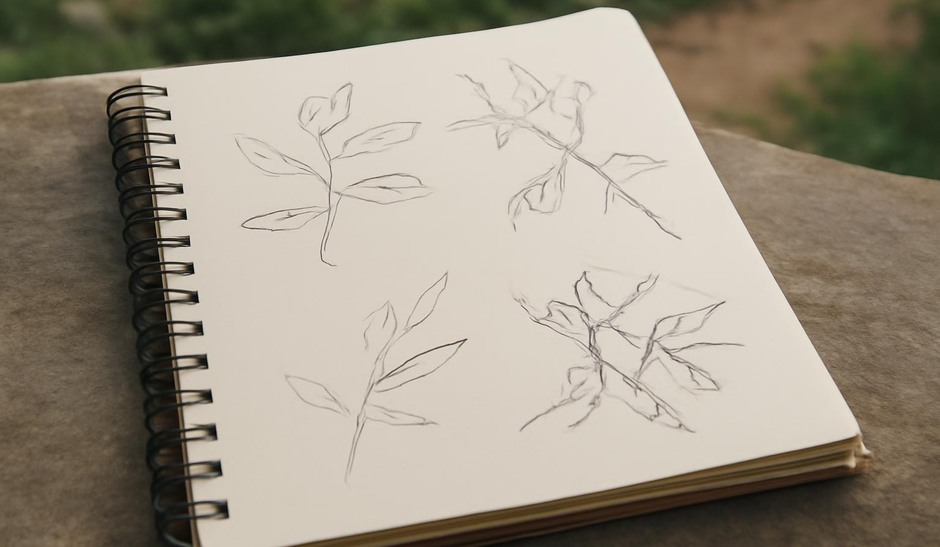
Blind contour drawing requires you to look at the subject and draw its edges without looking at the paper. The hand follows the eye, producing a line that maps the subject’s outline and internal contours in a single continuous observation.
- How to work: choose a single subject and move your gaze slowly along its edges while your pen traces the same path. Do not lift the pen or peek at the page.
- What it trains: close, uninterrupted observation, hand-eye coordination, and attention to subtle shifts in edge direction.
Blind contour drawings are rarely accurate in the way we expect, but they often capture structural relationships and encourage seeing detail rather than labeling shapes by memory.
Continuous line
Continuous line drawing keeps one unbroken line but allows glances at the paper. This method introduces more control while preserving the fluent mark-making of blind contour.
- How to work: set an intention to keep the pen moving and avoid lifting it between major elements. Look back at the subject periodically to correct proportion.
- What it trains: a balance between fluid mark-making and proportion management, helpful for mapping connected forms such as branch networks.
Continuous line sketches often read as rhythmic and cohesive. They are useful for recording networks of lines like twigs, leaf patterns, or the interlacing of roots.
Gesture sketches
Gesture sketches are timed marks that capture movement, density, and the major directional energies of a subject. Rather than focusing on precise edges, gestures aim to record weight, tilt, and the primary arcs that define a pose.
- How to work: set short intervals (30 seconds to 2 minutes) and make rapid marks that indicate the subject’s main axes and volumes.
- What it trains: seeing the big picture quickly and prioritizing structural information over detail.
Gesture work is particularly useful with subjects that change over time, such as clouds, swaying branches, or animals and people moving through a landscape.
Combining the methods
These three approaches can be used in sequence during the same field session. Start with a few timed gestures to establish proportions and energy, follow with a continuous line to connect major forms, and finish with a blind contour to sharpen attention to edges. The sequence allows different aspects of seeing to reinforce one another: gesture provides the structure, continuous line refines relationships, and blind contour deepens attention to surface detail.
Another practical routine is to pick one method for a week and then rotate. Notice how your perception and mark-making change. Blind contour may initially feel awkward, but it can make later lines more confident. Gesture exercises shorten reaction time to new scenes. Continuous line often produces work with a pleasing visual rhythm that can be developed into larger studies.
None of these exercises aims to produce finished work in the field. Their utility is in training a visual habit. The sketches become memory anchors and compositional cues for more deliberate studio pieces. Treat them as short investigations: simple, repeatable, and cumulative in their effect on observation skills.